All work
University group coursework 2025
QR Code Generator
A three-person university coursework project that constructs Version 1 and 2 QR codes from the specification, with a Flask interface for custom colours, module shapes, and output sizing.
Brief
- Coursework: This was a three-person project for the Programming in Python module at the University of Reading.
- Team: I worked with Joao Sousa and Jonathan Cronin. The project is presented as collaborative work rather than as a solo implementation.
- Technical ambition: Instead of wrapping an existing QR-generation package, we implemented the encoding, matrix construction, masking, and format-information stages ourselves.
- Supported subset: The implementation covers QR Versions 1 and 2, ISO-8859-1 Byte Mode, and Level-L error correction.
Team delivery
- Shared implementation: The encoder, matrix builder, mask scorer, image renderer, and Flask interface were integrated into one workflow.
- Attribution: The repository credits all three authors. Because it does not preserve reliable per-module ownership, I describe the implementation as shared work.
Implementation
- Encoding: Input is encoded in ISO-8859-1 Byte Mode. Versions 1-L and 2-L have 19 and 34 data codewords respectively; after encoding overhead, their input capacities are 17 and 32 bytes.
- Error correction: Reed-Solomon error-correction codewords are generated through
reedsolo. - Matrix construction: Python lists represent the QR matrix while finder, alignment, timing, dark, and format modules are placed around the encoded data.
- Mask selection: All eight standard mask patterns are scored, and the lowest-penalty result is selected.
- Web interface: Flask handles form submissions and Pillow renders the generated matrix as a PNG.
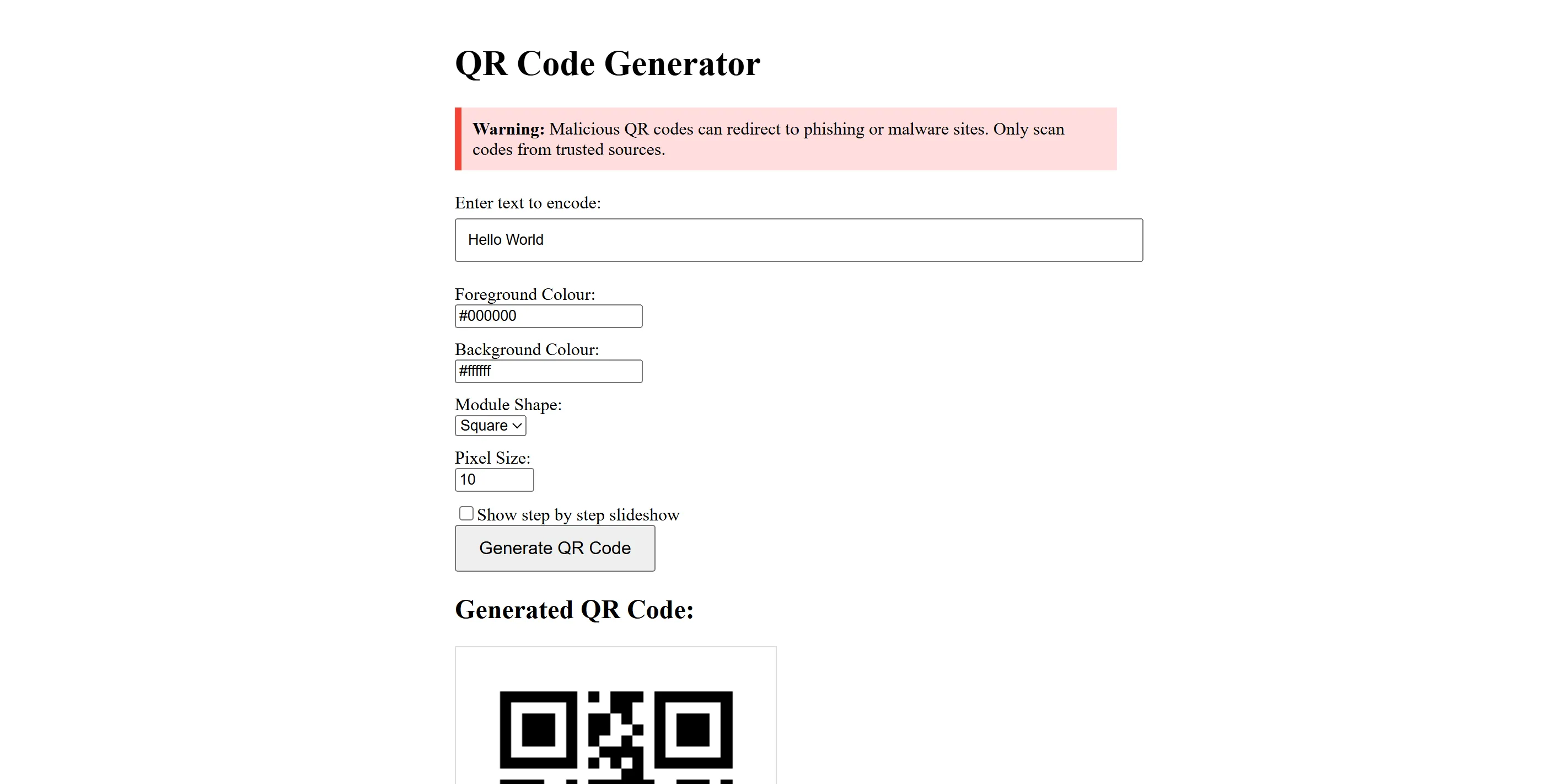
- Options: Users can choose foreground and background colours, square or circular modules, pixel size, and an optional slideshow of the construction stages.
Testing
- Demonstration: The repository records a
Hello Worldexample and intermediate images for pattern placement, data placement, masking, and format information. - Boundary handling: The interface rejects unsupported characters and inputs over 34 bytes. Its version-selection checks currently confuse data-codeword capacity with input capacity, so boundary-length inputs need correction and regression tests.
- Evidence limit: The repository has no automated test suite or recorded cross-device scan matrix, so I only claim the Version 1 and 2 workflow demonstrated there.
Outcome
- Result: The project produced a working Flask demonstration of the QR-construction pipeline within its defined Version 1 and 2, Byte Mode, and Level-L boundaries.
- Limitations: It does not support larger versions, other encoding modes, or additional error-correction levels. Inputs of 18–19 bytes need Version 2, and 33–34 bytes exceed the supported Byte Mode capacity; the current interface does not handle these boundaries correctly.
- Learning: Building each stage showed how the bitstream, error-correction codewords, mask, and final matrix depend on one another.
- Next step: Add automated reference-matrix tests and scanner checks before extending the supported standard.